A heat pump provides both heating and cooling by moving heat rather than generating it through combustion, which makes it well suited to Sacramento’s hot summers and mild winters. Impact Air Solutions installs heat pump systems for homeowners throughout Sacramento and the Greater Sacramento area, including gas-to-electric conversions and straight replacements of aging heat pumps. The right system depends on your home, your ductwork, your electrical panel, and what you actually want the system to do. We evaluate all of that before recommending equipment, and we will tell you plainly if a heat pump is not the right answer for your house.
Licensed HVAC contractor. CSLB #1074293.
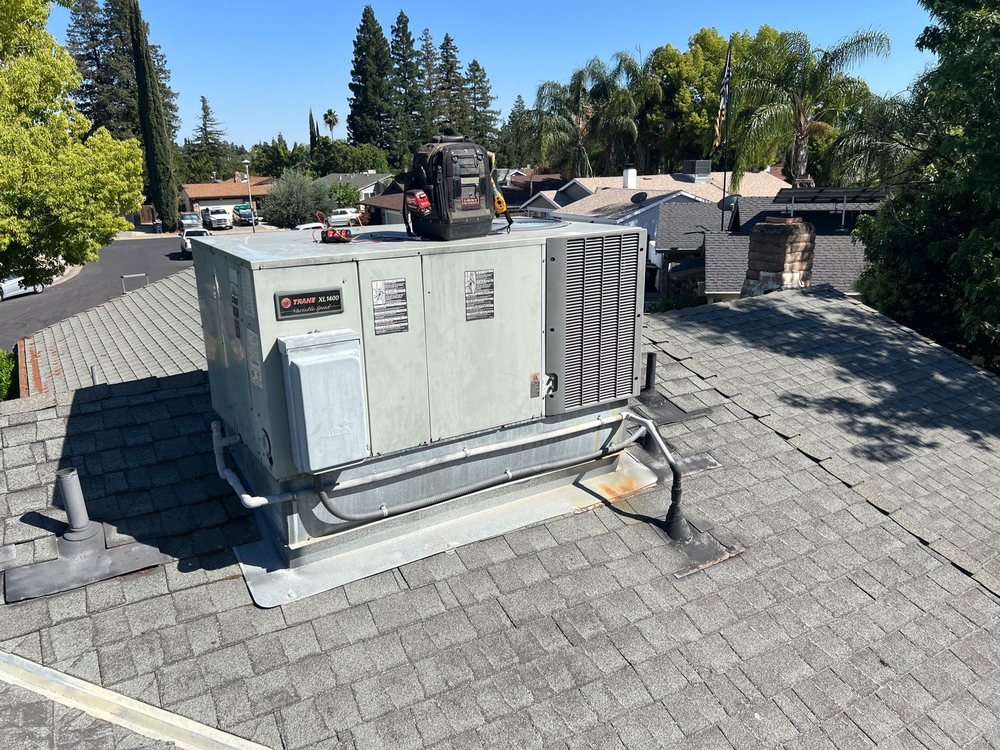
What a Heat Pump Is and How It Works
A heat pump is a single system that both heats and cools a home by transferring heat rather than creating it. In summer it moves heat out of the house, working the same way an air conditioner does. In winter it reverses, extracting heat from the outdoor air and moving it inside. Because it moves existing heat instead of burning fuel to produce it, a heat pump can deliver more heating energy than the electrical energy it consumes.
That last point is the core of the efficiency argument. A gas furnace can only ever deliver a fraction of the energy contained in the fuel it burns. A heat pump is not limited that way, because it is not converting fuel into heat, it is relocating heat that already exists.
In practical terms for a Sacramento homeowner, a heat pump replaces two pieces of equipment with one. Instead of a gas furnace for heating and a separate air conditioner for cooling, a single system handles both.
Heat pumps and Sacramento’s climate
Sacramento is a favorable climate for heat pumps. Winters are mild, with December average lows around 39°F and average highs in the mid 50s, which keeps the system operating in the range where it performs most efficiently. The colder-climate concerns that dominate heat pump discussions in other parts of the country apply much less here.
The demanding season in Sacramento is summer, not winter. July average highs sit in the low-to-mid 90s with essentially no rainfall, and the cooling season runs roughly April through October. A heat pump installed in Sacramento will do most of its annual work in cooling mode, which means it should be sized and selected primarily as a cooling system that also heats, not the other way around.
Heat Pump Installation Options in Sacramento
There are three common scenarios, and they have quite different costs and considerations.
Replacing an existing heat pump
The most straightforward case. The home already has a heat pump, the ductwork and electrical service are in place, and the project is an equipment changeout. The main decisions are sizing, efficiency level, and whether the existing ductwork should be repaired or improved while the system is open.
Converting from a gas furnace and separate AC
The most common Sacramento project and the one that carries the largest available rebates. A gas furnace and separate air conditioner are replaced by a single heat pump system. This requires evaluating whether the existing electrical panel and circuit can support the new equipment, since some older homes need panel or circuit work. Gas service to the home is not necessarily removed, since water heating, cooking, and other appliances may still use it.
Dual fuel, or a hybrid system
A heat pump paired with a gas furnace, where the heat pump handles most heating and the furnace covers the coldest conditions. In much of the country this is the default recommendation. In Sacramento’s mild winters the case for dual fuel is weaker than it is in colder climates, and for many homes a well-sized standard heat pump handles the heating season without a backup furnace. Whether dual fuel makes sense for a particular home depends on the house, the existing equipment, and the homeowner’s priorities, and it is worth an actual conversation rather than a default answer.
Ducted or ductless
Most Sacramento homes with existing ductwork are candidates for a ducted system. Ductless mini-splits are typically used for additions, converted garages, rooms the existing system never served well, or homes without ductwork. A mixed approach is sometimes the right answer, using a ducted system for the main house and a ductless head for a problem room.
Heat Pump Rebates and Incentives in Sacramento
This is the part of a heat pump decision where homeowners most often encounter outdated information, so here is the current picture.
The federal tax credit has expired
The federal Section 25C Energy Efficient Home Improvement Credit, which offered up to $2,000 toward a qualifying heat pump, was terminated by the One Big Beautiful Bill Act, signed into law July 4, 2025. The credit applies only to systems placed in service on or before December 31, 2025. A heat pump installed in 2026 does not qualify, regardless of when the equipment was ordered or the contract signed, because eligibility is based on when the system was placed in service.
A great deal of HVAC marketing content still advertises this credit, because it was written before the law changed. If a contractor’s quote includes a $2,000 federal tax credit for a 2026 installation, that quote is wrong.
SMUD increased its heat pump rebates in February 2026
SMUD announced increased residential heat pump rebate levels in February 2026, stating that the increases were designed to help offset the recent expiration of federal tax credits and state incentive programs. As announced, the levels are:
- Up to $3,000 for gas-to-electric heat pump HVAC system conversions
- $1,000 for electric-to-electric heat pump HVAC upgrades
- Up to $4,000 for gas-to-electric heat pump water heater conversions
SMUD has described its heat pump programs as a cornerstone of its 2030 Zero Carbon Plan and its goal to electrify 154,000 homes by 2030, noting that more than 23,000 gas-fired space and water heating systems have already been replaced through its Advanced Home Solutions program.
Rebate amounts and program terms are set by SMUD and can change. Confirm current amounts and requirements at smud.org before making a decision that depends on a rebate.
Your address has to be in SMUD territory
SMUD’s rebates apply only to addresses within SMUD’s electric service territory. That covers most of Sacramento County, but it does not include Roseville, Rocklin, or several other surrounding communities, which are served by other utilities. If you are outside Sacramento County, check your utility rather than assuming Sacramento rebate information applies.
Statewide programs
California’s statewide single-family heat pump incentive programs, including TECH Clean California and the single-family portion of HEEHRA, have been reported as fully reserved. California’s GoGreen Financing program offers low-interest financing rather than rebates and remains available statewide. Program status changes, so verify before counting on any of it.
What a Proper Heat Pump Installation Involves
The equipment matters less than the installation. A correctly selected heat pump installed poorly will underperform a mid-range system installed well. Here is what a thorough process covers.
- Load calculation. Determining how much heating and cooling the house actually needs, based on square footage, insulation, windows, orientation, and air leakage, rather than matching the size of the old equipment. Systems are frequently oversized because the previous system was oversized and nobody recalculated.
- Duct evaluation. Existing ductwork has to be able to move the airflow the new system requires. This is where many installations quietly fail. ENERGY STAR estimates that roughly 20 to 30 percent of the air moving through a typical home’s duct system is lost to leaks, holes, and poor connections, and the U.S. Department of Energy’s Building America program notes that placing ducts in an unconditioned vented attic typically increases heating and cooling energy use by about 10 percent. Installing efficient equipment onto a leaking duct system gives away much of what you paid for.
- Electrical assessment. Confirming the panel, circuit, and disconnect can support the equipment. Gas-to-electric conversions sometimes require panel or circuit work, and finding that out during the install rather than during the quote is a bad experience for everyone.
- Equipment selection. Matching the system to the load calculation and to what the homeowner actually wants, including efficiency level, staging or variable capacity, and noise considerations.
- Permit and code compliance. Covered in the next section.
- Commissioning and verification. Confirming refrigerant charge, airflow, and that the system performs as designed, rather than assuming it does because it turns on.
What we will tell you honestly
If your ductwork cannot support the system, we will say so before installing, not after. If your panel needs work, that belongs in the quote. And if a heat pump is not the right answer for your particular home, we would rather tell you that than sell you one.
Permits and Code Requirements for Heat Pump Installation in California
Heat pump installations and changeouts in California are regulated alterations under Title 24, the state’s Building Energy Efficiency Standards. In most cases that means a permit is required and third-party verification is performed by a certified rater, with the verification documents used to close out the permit.
One change worth knowing about: under the 2025 Energy Code, which applies to permit applications submitted on or after January 1, 2026, heat pump changeouts require refrigerant charge verification in all California climate zones. Sacramento is in California Climate Zone 12. As of January 1, 2026, the California Energy Commission also renamed the code-compliance side of the HERS program to ECC, or Energy Code Compliance, so “HERS rater” and “ECC rater” may both appear on documents. The field tests, forms, and registries are the same.
The practical takeaway for a homeowner: a permit and verification are part of a properly done heat pump installation in Sacramento, and they should appear in the quote. A contractor who offers to skip the permit is not saving you money, they are transferring risk. Unpermitted equipment work tends to surface at the point of sale.
Refrigerants in New Heat Pump Systems
New residential heat pumps installed today use lower global warming potential refrigerants, most commonly R-454B or R-32, rather than the R-410A that was standard for roughly two decades. This is the result of the federal AIM Act’s Technology Transitions rule, under which manufacturers stopped producing new residential split-system air conditioners and heat pumps using R-410A as of January 1, 2025.
If you currently have an R-410A system, this does not mean you have to replace it. R-410A remains legal for servicing existing equipment and there is no requirement for homeowners to replace working systems. What it does mean is that refrigerant costs for repairing older systems are generally expected to rise as production allowances tighten, which is a legitimate consideration when you are already weighing a replacement, and not a reason to be pressured into one.
Is a Heat Pump Right for Your Sacramento Home?
A heat pump is often a good fit when:
- The existing air conditioner and gas furnace are both nearing end of life, so you are replacing both anyway
- The home is in SMUD territory and can access the gas-to-electric conversion rebate
- The ductwork is in reasonable condition or can be brought there as part of the project
- The electrical panel has capacity, or panel work is acceptable within the budget
- You want one system handling both heating and cooling
A heat pump may not be the right answer when:
- The gas furnace is relatively new and in good condition, making replacement of a working appliance hard to justify
- The ductwork has significant problems that the budget cannot address, since the system will underperform regardless of equipment quality
- Electrical constraints would make the project substantially more expensive than the alternatives
- The home has an unusual layout or use pattern that a different approach serves better
Impact Air Solutions would rather evaluate your specific situation and give you a straight answer than assume the largest project is the right one.
Why Sacramento Homeowners Choose Impact Air Solutions for Heat Pump Installation
- We size the system to the house. Load calculation first, equipment second.
- We evaluate the ductwork before we install. The best equipment on a failing duct system is wasted money, and you should hear that before you spend it.
- We handle the permit and verification. They are part of doing the job correctly in California.
- We tell you when the answer is no. Including when a heat pump is not the right fit for your home.
- We give current, accurate incentive information. Rather than quoting a federal credit that ended in 2025.
- Licensed and accountable. CSLB #1074293.
Frequently Asked Questions About Heat Pump Installation in Sacramento
Yes. Sacramento’s mild winters, with December average lows around 39°F, keep a heat pump operating in the range where it performs efficiently, and the cold-climate performance concerns common in other regions apply much less here. Sacramento’s demanding season is summer, so a heat pump installed here does most of its annual work in cooling mode and should be sized accordingly.
No. The federal Section 25C Energy Efficient Home Improvement Credit, which offered up to $2,000 for a qualifying heat pump, was terminated by the One Big Beautiful Bill Act for systems placed in service after December 31, 2025. A heat pump installed in 2026 does not qualify, regardless of when it was purchased or ordered, because eligibility depends on when the system was placed in service. Utility rebates are separate and remain available.
SMUD announced increased residential heat pump rebates in February 2026, including up to $3,000 for gas-to-electric heat pump HVAC conversions and $1,000 for electric-to-electric heat pump HVAC upgrades, along with up to $4,000 for gas-to-electric heat pump water heater conversions. Amounts and terms are set by SMUD and can change, and the address must be within SMUD’s electric service territory. Confirm current details at smud.org before making a decision based on a rebate.
No. SMUD’s rebates apply only to addresses inside SMUD’s electric service territory, which does not include Roseville or Rocklin. Roseville is served by Roseville Electric Utility, the city’s own municipal utility, and Rocklin is served by PG&E with generation procured through Pioneer Community Energy. Check with your own utility for programs available in those cities.
In most cases, yes. Heat pump installations and changeouts are regulated alterations under California’s Title 24 energy code, generally requiring a permit and third-party verification by a certified rater. Under the 2025 Energy Code, which applies to permits applied for on or after January 1, 2026, heat pump changeouts require refrigerant charge verification in all California climate zones. The verification documents are used to close out the permit.
It can. A heat pump handles both heating and cooling, so a single system can replace a gas furnace and a separate air conditioner. Some homeowners choose a dual fuel setup that keeps a gas furnace for the coldest conditions, though in Sacramento’s mild winters the case for dual fuel is weaker than in colder climates. Note that removing a gas furnace does not necessarily mean removing gas service, since water heating and cooking may still use it.
(CONTENT TO BE CONFIRMED)
Not always, but it must be evaluated. Existing ductwork has to move the airflow the new system requires, and leaks reduce the benefit of efficient equipment. ENERGY STAR estimates roughly 20 to 30 percent of the air in a typical duct system is lost to leaks and poor connections. Repairs or sealing are often enough, and full replacement is less common than complete duct repair. This should be assessed before equipment is selected, not discovered afterward.
Talk Through a Heat Pump for Your Sacramento Home
Impact Air Solutions will look at your home, your ductwork, and your electrical service, explain what a heat pump would and would not do for you, give you current and accurate information about available rebates, and let you decide.
Problem Solved. Peace of Mind Delivered.
Licensed HVAC contractor. CSLB #1074293.